(The title of this blog sounds like I made it using one of those YA book title generators.)
At this point, I barely know where to begin. The first semester of this year seems like a dream, like something that maybe happened but probably didn’t. Even the beginning of the second semester, the time spent in the classroom from late January to early March, seems only vaguely real. Will I even remember how to function in a real classroom by the time I actually get back there?
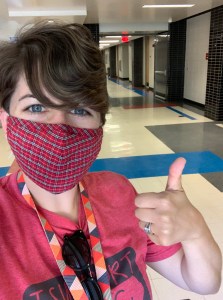
I have been really stretching myself to try to remember first semester. In contrast to the reality of second semester, it was one of those nearly perfect semesters where every class is full of students you love. (Sure, there’s always one bad apple but the overwhelming amount of great kids renders said student irrelevant.) My freshman were pushed out of their comfort zones and grappled with challenging materials like pros. I was on my A-game with planning cross-curricular, student-centered, active lessons. My sophomores were a tougher group, but we bonded over music, my weird quirks (which they loved to dissect), and the literature we read. They begged to read more each day, and they made me want to have my own kids immediately if only so they could grow up to be as fantastic as the students in that class. Essentially, fall semester was basically paradise.
Then, disaster struck. The COVID-19 pandemic closed schools which sent this extraverted teacher on a downward spiral. My job was reduced to all of my very least favorite parts about teaching: meetings, grading, lesson planning, and very, very little student interaction. I soldiered on, however, and managed to cross the metaphorical finish line despite my distaste for remote learning. And, now, as I sit here writing this, I wonder what, if anything, I even learned this year. I had a student teacher with whom I felt like I barely had enough time. I lead student council, but I didn’t lead it through one of the biggest events of the year (prom). I created a English III course centered on the tragic hero which would culminate in an incredible project on the value of the tragic hero in literature, but I never got to implement the project. The very thing that made the first semester so great was what made the second semester so terrible: once schools closed, the steam I spent all year building abruptly ended. Relationships were cut off, projects fell apart regardless of how much I tried to make them work digitally, and my own personal motivation came to a screeching halt.
Instead of, then, offering what I learned this school year because, admittedly, I learned very little (unless you count the fact that maybe I learned we, as a society, know very little about a very large number of things), I would like to offer a brief reflection on The Hollow Men by T. S. Eliot as it strikes me as more and more relevant to our current situation. If you don’t recognize the title, you probably have read it or, at least, will recognize some of its famous lines. The New York Times, upon T. S. Eliot’s death, said the last four lines of The Hollow Men are “probably the most quoted lines of any 20th-century poet writing in English.” Therefore, I will start there:
This is the way the world ends
This is the way the world ends
This is the way the world ends
Not with a bang but a whimper.
Eliot has never been clear about the exact meaning of his poem; although, there has been much speculation and some things are for certain. He wrote The Hollow Men shortly after World War I, and it appears to be concerned with his distaste for the Treaty of Versailles among other things, such as religion and hope. To me, the poem remains relevant because of the ending. So often, great and impressive things, like war or pandemics or converting every school in the country to remote learning overnight, end without much fanfare. We didn’t celebrate the end of the school year so much as we just let it fizzle out. It’s a fair metaphor for the way the news cycle and, consequentially, society itself starts out with strong messaging about something or another, and then that thing fades into the background as others take its place. I’m definitely not saying this is right or good (In fact, I think it often harms us.); I am merely making an observation and a socio-textual connection.
I believe part of this issue lies in the disconnect between the hyped up version of life we see on social media, in the news, as part of reality TV, etc. and the actual reality we are forced to grapple with every day. Consider part V of Eliot’s poem. Before getting to the four famous final lines, he writes,
Between the idea
And the reality
Between the motion
And the act
Falls the ShadowFor Thine is the Kingdom
Between the conception
And the creation
Between the emotion
And the response
Falls the ShadowLife is very long
Between the desire
And the spasm
Between the potency
And the existence
Between the essence
And the descent
Falls the ShadowFor Thine is the Kingdom
Just reflect on those lines for a moment. There is a shadow that falls which obscures our ability to make our reality what we perceive it to be or what we want it to be. Or, maybe that shadow prevents us from seeing reality clearly. Much in the way I am unable to process the insanity of this year into something palatable, humans seem doomed to be blind to the realities they face every day. I think that’s why this pandemic has been difficult for so many people. It’s taken the reality we constructed for ourselves in our jobs, our schools, our relationships, and it’s thrown them into chaos. (Shadow, in this poem, is capitalized which leads me to believe that the Shadow is Satan due to the strong Christian imagery and Biblical allusions Eliot includes.)
I suppose this is quite a pessimistic view to reflect upon on the end of the school year, but I do think Eliot’s poem offers some hope. He chooses, in this very bleak moment, to integrate an allusion to the Lord’s Prayer. (And, for you Bible scholars who are about to argue that this particular line is not included in Matthew 6, I offer two things: (1) this article explaining why and, more importantly, (2) the idea that it doesn’t matter because, to Eliot, it was included and, therefore, it is what he’s referencing.) The words he quotes are “For Thine is the Kingdom” or, in layman’s terms, “the Kingdom is God’s”. The point of this line is that reality as well as the future world (after death) falls under God’s jurisdiction. We have no power here. The reality we know or the realities we construct are both irrelevant. Basically, if the world ends with a whimper instead of a bang, it doesn’t change the fact that God is in control. To me, and to Christians, this is hopeful not powerless. There is peace in knowing that we cannot control. There is peace in knowing that we do not have to control. Basically, what it comes down to is this: the pandemic and any number of other bleak realities we are facing are overshadowed by His power.
In close, I guess my point is that I didn’t learn much this school year, I didn’t get closure, and I don’t really fully comprehend the realities of this pandemic. I don’t have answers, but that doesn’t really matter. While my world may change rapidly, and it may spiral out of control, God does not. He is still in control and the Kingdom is His. For the end of this school year, I will rest in that reality.
Peace I leave with you; my peace I give you. I do not give to you as the world gives. Do not let your hearts be troubled and do not be afraid. – John 14:27
— Mads
 Kyle+Mads
3 thoughts on “Year 6: a Pandemic, T. S. Eliot, & the Unreality of It All”