“It feels like we’re building the plane while we’re flying it and the destination keeps changing on us.” – Heidi Crumrine, high school English teacher (Concord, N.H.)
Let me paint you a picture: it’s January 2020. COVID-19 is not a word in your vernacular yet. You may have a vague idea that it’s a type of serious disease affecting China, but it’s far away, like malaria in Africa, or maybe you believe it’s being blown out of proportion, like H1N1. You don’t think about it much; you have other things to worry about. January, for traditional high school teachers in NC, is the end of one semester and the beginning of another. There is grading and exams and preparation and new names to learn. Work piles up very quickly, but you are on your sixth year of teaching. The high you’ve experienced from first semester lingers: first semester was some of the best teaching you’ve ever done. Then, March hits. Schools move online. The entire world stops, shuts down, stays quiet. You sit in your house and contemplate how you can maintain a high level of learning and engagement from the other side of a computer screen. (To read more about my experience teaching last year, go here.) “Surely,” you think, “this will all be over by the time the new school year starts.”
You know what happens next. The school year opens with little fanfare. Instead of students flooding into the school buildings across the country, they log-in online to the join what must be the weirdest experiment in public education in decades. For an entire semester, I taught students via Google Meet. Most students kept their cameras off and didn’t unmute at all. I worked on trying to engage them, pull them in, treat them with grace and kindness and lack of deadlines. I tried to figure out how to balance rigor and their mental health. I learned new online tools, troubleshooted, and went home exhausted every day. I found out I was pregnant 3 weeks into the school year and was thrust into even more uncertainty: how do you teach virtually and, more importantly, how do you deal with pregnancy in a pandemic? Like most people around the world, I was just sitting in a constant state of “I guess I’ll just figure it out.” I was, by the end of the first semester, surprisingly calm. I just kept reminding myself that I was doing the best I could. Students are resilient and still brilliant, and I am a good teacher regardless of my inability to teach at the same level virtually as I did in-person. (There were definitely low points and, certainly, like many teachers, my mental health has taken a hit. To read more about how and why teachers have struggled this year, check out this NPR article.)
The school year dragged slowly through the first semester, then–suddenly!–things sped up very, very quickly. I had a full-time student teacher, and terms like hybrid, asynchronous, and remote learning were becoming part of my everyday vocabulary. My district’s school board voted to open high schools schools on an extremely complicated 3-week rotation system. They voted on school opening guidelines, voted to adjust the calendar, voted to allow students to choose if they wanted to be in-person or virtual, voted to change the calendar again… The district wrote distancing guidelines, attendance guidelines, lunch guidelines, mask guidelines… The calendar changed again… The school reorganized, created one-way hallways, assigned extra duties… The calendar changed again… Everything was in a constant state of flux. There were so many changes that it felt like our whole education system had a terrible case of whiplash. By the time it was announced that teachers could get vaccinated, I was so confused by my position on vaccines and pregnancy, I barely had time to comprehend what was happening before the board voted to bring back all students full-time who wanted to return. Classes at my school would all be taught “concurrently.” (I have been told this is the more appropriate word for teaching students both online and in-person at the same time as opposed to hybrid. I am still unclear as to why.)
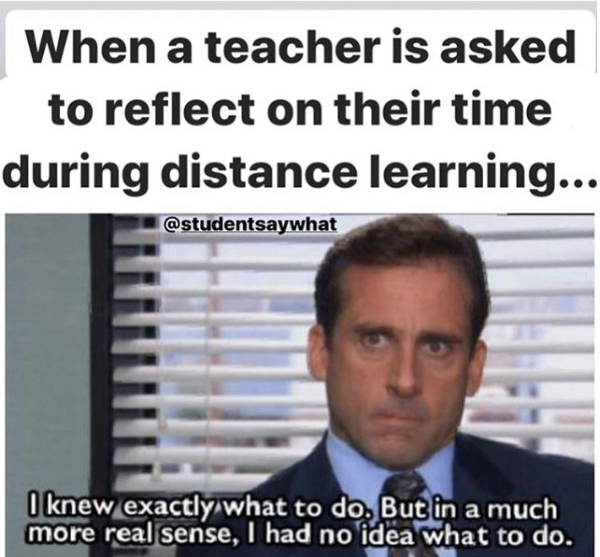
As I begin my maternity leave, I am trying to comprehend what I learned–if I learned anything at all. I learned not to take on a student teacher in the middle of a pandemic because that’s unnecessarily stressful. I learned that virtual teaching is nothing like in-person teaching, and I am not very good at it. I learned that the bathroom is always the farthest spot in the school from your classroom–but only when you’re pregnant. I learned that even people who are Type A, like me, can embrace the motto “it is what it is.” I learned that you can, for the most part, suffer through anything if you know it’s going to end eventually. (My teaching life this year–especially in the last month–reminds me of that episode of Unbreakable Kimmy Schmidt in which Kimmy says, “You can do anything for 10 seconds,” then proceeds to count to 10, then count to 10 again, then count to 10 again, and so on.) It’s possible that, when schools return to normal, I might look back and be able to better reflect and actually come up with an idea of what this mess of a school year has taught me. For now, I want to offer this to my friends and colleagues who still have five weeks left to survive:
- You are strong. The end of this school year, especially, probably feels like it’s dragging you down the hallway. Fight back. You can do it! Teachers have always been stronger than anyone gives us credit for.
- It’s okay to hate teaching this year. Heck, it’s fine to hate it any year, but it’s especially okay this year. None of us signed up for this mess. None of us were trained for this.
- Remember the good stuff. When the days are beating you down, remember the parts about teaching you love–even now. Latch onto a joke a student made, a colleague complimenting you, or the way the sun looks when it rises behind the school building. Hang tight to that. If you can’t, hang on to what you love outside school: your family, a hobby, that glass of wine that’s waiting for you at home…
- Taking a mental health days is important and just as necessary as taking a sick day for physical illness. If you don’t feel strong, hate teaching, and can’t remember the good stuff, take a break. Put in for leave. The students will be fine for one day without you, I promise.
- Let it go when you go. On the last day of the school year, pull out of the parking lot, and don’t look back. Don’t think about next school year until you pull back into the parking lot in late August. Seriously. You need a break.
— Mads
 Kyle+Mads
2 thoughts on “Year 7: Whiplash, Bathroom Breaks, & the Worst Teaching I’ve Ever Done”